Namaste. I am Rohit, a guide. I have been helping pilgrims for the past 8 years. And in those years, I have learned that Sawan in Kashi is not a month you visit. It is a month you survive — beautifully, if you plan it right.
The city turns saffron. Barefoot Kanwariyas walk in from the highways, balancing bamboo poles with pots of Ganga water on their shoulders. The chants of "Bol Bam" and "Har Har Mahadev" start before dawn and do not stop until well after dark. And at the centre of it all stands Kashi Vishwanath, the Jyotirlinga that Shiva is said never to leave.
But the same devotion that makes Sawan extraordinary also makes it exhausting. Queues stretch for hours. Roads close. Boats are suspended. And pilgrims who arrive unprepared spend their day in a line instead of in darshan.
This guide covers everything you need to know about Sawan Somvar at Kashi Vishwanath and the Kanwar route. The dates, the timings, the traffic plan, the rituals, and the practical tips that make the difference between a blessing and an ordeal.
Let us begin.
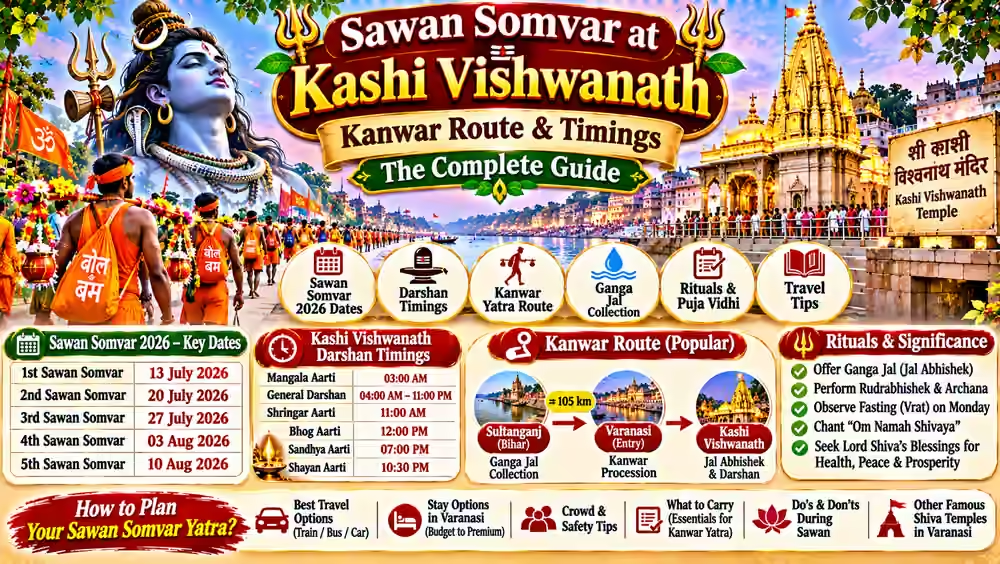
Sawan 2026 – Dates and the Four Somwars
In North India, the Purnimanta calendar places Sawan 2026 from 30 July to 28 August.
| Event | Date |
|---|---|
| Sawan Begins | Thursday, 30 July 2026 |
| First Sawan Somwar | Monday, 3 August 2026 |
| Second Sawan Somwar | Monday, 10 August 2026 |
| Sawan Shivratri | Tuesday, 11 August 2026 |
| Third Sawan Somwar | Monday, 17 August 2026 |
| Fourth Sawan Somwar | Monday, 24 August 2026 |
| Sawan Ends | Friday, 28 August 2026 |
Source: HelloBanaras and India TV.
What This Means:
-
The four Mondays are the peak crowd days at Kashi Vishwanath
-
Sawan Shivratri on 11 August is another major crowd day, falling between the second and third Somwars
-
The Kanwar Yatra builds through these weeks and peaks around the Somwars and Shivratri
The Honest Advice: If your goal is an unhurried darshan, avoid the four Mondays and Shivratri. If your goal is to feel the full intensity of collective devotion, plan straight into one of them.
Why Sawan Is Shiva's Month
Sawan is dedicated to Lord Shiva. The traditional story is that during the churning of the cosmic ocean (Samudra Manthan), a terrible poison called halahala rose to the surface and threatened all creation. Shiva drank it and held it in his throat, which turned blue — earning him the name Neelkanth.
To soothe the heat of the poison, the gods and devotees offered him holy water. The monsoon rains of Sawan are seen as a continuation of that cooling compassion. That is why carrying Ganga water to a Shiva temple in this month is considered especially blessed.
In Kashi, the city Shiva never leaves, this devotion reaches its absolute peak.
Kashi Vishwanath Darshan Timings During Sawan
Kashi Vishwanath Temple follows a fixed daily schedule, with some Sawan-specific adjustments.
| Ritual / Window | Timing |
|---|---|
| Temple Opens | Around 2:30–3:00 AM |
| Mangala Aarti (ticketed) | 3:00–4:00 AM |
| General Darshan – Morning | 4:00–11:00 AM |
| Bhog Aarti | 11:15 AM–12:20 PM |
| Afternoon Darshan | 12:00 Noon–7:00 PM |
| Night Shringar / Bhog Aarti | 9:00–10:15 PM |
| Temple Closes | Around 11:00 PM |
Source: Mandir Timings and The Mandir Yatra.
Sawan-Specific Arrangements:
For Kashi residents, a separate entry route has been arranged during Sawan. They can do darshan through Gate No. 4 from 4:15 AM to 10:45 PM. This is the first time such an arrangement has been made.
For Kashi residents, tableau darshan (a brief ritual viewing) is available daily from 4:00–5:00 AM and 4:00–5:00 PM, except on Sawan Mondays and festival days.
What This Means for Outstation Pilgrims:
-
The general queue applies to you
-
The temple is open for a long window, but the queue decides how long you actually spend inside
-
Plan for the morning window (4:00–7:00 AM) if you want the calmest darshan
The Sawan Somwar Queue Reality
This is the part that decides your day.
The Numbers:
-
On Somwars, the queue runs 4–6 hours
-
Kashi Vishwanath sees close to 10 million pilgrims across the full month
-
Daily footfall is 1.5–2 lakh devotees, with considerably more on Mondays
Why It Happens:
-
Kanwariyas arrive on foot with Ganga water and join the darshan queue
-
Local devotees observe the Somwar vrat and visit the temple
-
The corridor funnels everyone through the same approach
What You Should Do:
-
Arrive by 3:30–4:00 AM if you are joining the general queue
-
Use Sugam Darshan if you want to cut the wait
-
Avoid the 8:00 AM–12:00 PM window — it is the worst of the day
-
Do not plan a train or flight on the same afternoon — the queue can eat your buffer
Sugam Darshan – The Pass That Changes Everything
The Sugam Darshan is the official fast-track pass for Kashi Vishwanath. It costs about ₹300 and is booked through the temple trust's official channels.
What It Does:
-
Puts you in a shorter, separate queue
-
Reduces the wait from 4–6 hours to a much more manageable window
-
Is the single most practical step for elderly pilgrims and families
What It Does Not Do:
-
It does not guarantee instant darshan
-
It does not allow photography inside the sanctum
-
It is not a "VIP" experience — it is simply a faster queue
The Honest Note: If you are visiting on a Sawan Somwar with parents or children, buy the Sugam Darshan. The ₹300 is the best money you will spend on the trip.
Jalabhishek and Rudrabhishek at the Temple
The central ritual of Sawan at Kashi Vishwanath is Jalabhishek — pouring holy water over the Shivling.
Jalabhishek:
-
Performed with Ganga water
-
Offered at the Shivling inside the sanctum
-
Kanwariyas carry the water on foot from the ghats or from far-off sources
Rudrabhishek:
-
A more elaborate ritual performed by priests
-
Involves milk, curd, honey, ghee, and Ganga water
-
Booked separately through the temple trust
-
Takes longer and requires a priest's coordination
What to Expect:
-
The sanctum is crowded
-
You will be moved along quickly
-
The priest will accept your offering and pour it over the Lingam
-
You will have a few seconds of darshan before moving on
The Practical Tip: If you want a calmer abhishek, book a Rudrabhishek rather than joining the general Jalabhishek queue. It is a scheduled ritual, not a crowd experience.
The Kanwar Yatra – What It Is
The Kanwar Yatra is one of the largest annual pilgrimages on earth.
What Happens:
-
Devotees called Kanwariyas collect holy Ganga water in pots
-
The pots are slung from a bamboo pole called a kanwar
-
They carry it on foot, often for hundreds of kilometres
-
They offer it at a Shiva temple — most commonly Kashi Vishwanath
The Discipline:
-
Many walk barefoot
-
They observe fasts and abstain from certain foods
-
The kanwar must never touch the ground until the journey is complete
-
The pots are held aloft or hung from stands even during rest
The Chants:
-
"Bol Bam"
-
"Bam Bam Bhole"
-
"Har Har Mahadev"
Why It Matters:
The Yatra is a vow of devotion and endurance, undertaken by farmers, students, labourers, shopkeepers, the young and the old, walking together under the monsoon sky.
The Kanwar Route into Varanasi
The route into the city is managed by the Varanasi Police Commissionerate, and it changes the way you move through the city during Sawan.
The Reserved Kanwar Route:
| Segment | Detail |
|---|---|
| Entry Point | Gudiya Border (Mirzapur, on the Varanasi border) |
| Route | Gudiya Border → Rakhaura Underpass → Rajatalab → Mohansarai → Mudaila Tiraha → Chandpur |
| Reserved Lane | The left-hand lane of this stretch is reserved for Kanwar vehicles only, for the entire month of Sawan |
| No Other Vehicles | No other vehicle is allowed on this lane |
Source: Amar Ujala.
What This Means:
-
If you are driving into Varanasi from the south or west during Sawan, expect diversions
-
The Kanwar route is not for regular traffic
-
Buses and private vehicles are rerouted via NH-19 → Rakhaura Overbridge → Ring Road → Harhua
No-Vehicle Zones and Traffic Diversions
The final approach to Kashi Vishwanath is pedestrian-only during Sawan.
What Is Declared No-Vehicle:
| Zone | Detail |
|---|---|
| Approach roads to Kashi Vishwanath Dham | No-vehicle zone |
| Route to Dashashwamedh Ghat | Pedestrian only |
| Maidagin–Chowk–Godowlia | No-vehicle zone, daily |
| Godowlia–Dashashwamedh Ghat | No-vehicle zone |
| Benia–Ramapura–Khari Kuan–Jangambadi–Sonarpura–Madanpura–Godowlia | Pedestrian only from Sunday night to Tuesday 6:00 AM |
Source: Amar Ujala.
The Regular No-Entry:
The regular no-entry restriction, which normally opens at 11:00 PM on Sundays and Mondays, will not be opened during Sawan. This means the restrictions stay in place longer.
Exemptions:
Vegetable, fruit, milk, newspaper, and LPG vehicles are exempt from these restrictions.
What This Means for You:
-
Your taxi cannot reach the temple gate
-
You will be dropped at a perimeter point and walk the last stretch
-
Plan for 700 metres to 1.2 km of walking depending on your drop point
The Practical Drop Points:
-
Benia Bagh
-
Girjaghar / Church Crossing
-
Maidagin Crossing
-
Bhelupur Crossing
Where to Witness the Kanwar Yatra in Varanasi
You do not need to join the queue to experience the Yatra. You can watch it.
| Location | What You See |
|---|---|
| Gudiya Border | The entry point — the first wave of Kanwariyas |
| Rajatalab | The main arterial stretch |
| Mohansarai | A key junction on the route |
| Dashashwamedh Ghat | Kanwariyas collecting Ganga water before the climb to the temple |
| Assi Ghat | Another major water collection point |
| Approach roads to Kashi Vishwanath | The final stretch, where the saffron stream narrows into the lanes |
The Honest Advice: The approach roads to Kashi Vishwanath are the most intense. If you want to watch without being caught in the crush, stand at Rajatalab or Mohansarai — you see the Yatra in full flow without the temple-gate squeeze.
Ganga Snan and Ghat Protocols
Many pilgrims begin Sawan darshan with a Ganga Snan at a ghat before walking to the temple.
Which Ghats:
-
Assi Ghat
-
Dashashwamedh Ghat
-
Lalita Ghat
-
Kedar Ghat
What to Know:
-
The ghats are crowded on Somwars
-
The monsoon can raise the river level, and some lower steps may be submerged
-
Boats are often suspended during high water
-
Do not enter the water if the current is strong
The Corridor Route:
Since the Kashi Vishwanath Corridor opened, a broad ceremonial pathway connects the sanctum directly to the Ganga at Lalita Ghat. This gives pilgrims a clear route from a riverside dip to the Jyotirlinga, which is especially helpful during Sawan crowds.
What to Offer at the Temple
| Offering | Why |
|---|---|
| Ganga water | For Jalabhishek |
| Bael leaves | Sacred to Shiva |
| Milk | For abhishek |
| Flowers | White or red |
| Fruits | Seasonal |
| Dhatura | Traditional Shiva offering |
What Not to Offer:
-
Anything non-vegetarian
-
Alcohol
-
Leather items inside the sanctum
Where to Stay During Sawan
| Area | Best For | Price Range |
|---|---|---|
| Near Dashashwamedh Ghat | Walking distance to the temple | ₹800–₹2,500 |
| Near Assi Ghat | Quieter, boutique stays | ₹1,500–₹4,000 |
| Cantt area | Wide roads, easy car access | ₹2,000–₹5,000 |
| Sigra | Budget hotels, families | ₹1,000–₹3,000 |
Recommendation: Stay near Assi Ghat or Dashashwamedh Ghat if you want to walk to the temple. Stay in Cantt or Sigra if you want car access and will take an early-morning auto to the perimeter drop point.
Important: Book 3–4 weeks in advance for Sawan Somwars. The ghat-side hotels fill first.
What to Wear and Carry
What to Wear:
-
Modest clothing covering shoulders and knees
-
Comfortable slip-on shoes (removed at the temple)
-
Light cotton — Sawan is humid
-
A light raincoat or umbrella
What to Carry:
-
Sugam Darshan pass (printed or digital)
-
Government photo ID
-
Cash (₹2,000–₹3,000)
-
Water bottle
-
Power bank
-
Basic medicines
-
A small bag for offerings
What Not to Carry:
-
Large bags
-
Expensive jewellery
-
Electronics inside the sanctum
Safety Tips for Somwar Crowds
1. Arrive Early
3:30–4:00 AM is the calmest window, even on Somwars.
2. Use Sugam Darshan
The ₹300 pass is the single best safety investment for families and elders.
3. Keep the Group Together
Agree on a meeting point outside the temple in case you get separated.
4. Watch the Weather
Sawan means rain. The lanes become slippery, and the ghats can flood.
5. Stay Hydrated
Humidity is high. Carry water and ORS.
6. Avoid the Temple-Gate Crush
If you are with children or elders, do not push into the final approach. Use the corridor route and the Sugam lane.
7. Do Not Carry Valuables
The crowds are dense. Leave jewellery and excess cash at the hotel.
Accessibility for Elders
| Facility | Availability |
|---|---|
| Sugam Darshan | Essential for elders |
| Wheelchair | Available at the temple |
| Corridor route | Flat, paved, easier than the old lanes |
| Rest points | Limited inside the temple, more in the corridor |
| Drop points | Benia Bagh, Girjaghar, Maidagin |
The Honest Advice: Do not bring elderly parents to a Sawan Somwar without a Sugam Darshan pass. The general queue is not manageable for them.
How to Reach Varanasi
By Air:
-
Lal Bahadur Shastri Airport (VNS) — 25 km from the city
-
Direct flights from Delhi, Mumbai, Bengaluru, Hyderabad, Chennai, Kolkata
By Train:
-
Varanasi Junction and Kashi Station — the main railheads
-
Direct trains from Delhi, Mumbai, Kolkata, and other major cities
By Road:
-
320 km from Lucknow
-
200 km from Ayodhya
-
120 km from Prayagraj
During Sawan:
-
Road routes are diverted around the Kanwar corridor
-
Buses travel via NH-19 → Rakhaura Overbridge → Ring Road → Harhua
-
Expect longer travel times
Final Words
Sawan at Kashi Vishwanath is not a quiet pilgrimage. It is a city-wide act of devotion — saffron Kanwariyas on the highways, Ganga water carried for hundreds of kilometres, and a queue that stretches for hours outside the Jyotirlinga.
You can fight it, or you can plan around it. Arrive early. Book the Sugam Darshan. Drop at Benia Bagh. Walk the corridor. And when you finally stand before the Lingam, let the noise fall away.
That is Sawan in Kashi. That is the month Shiva's city belongs entirely to him.
Har Har Mahadev.
Plan Your Sawan Somvar Darshan at Kashi Vishwanath
For bookings, queries, and custom packages:
Contact: Rohit - 7078723132
Hours: 8 AM to 9 PM daily
Our Services:
-
Sawan Somwar Darshan Planning
-
Sugam Darshan Pass Assistance
-
Fixed-Fare Perimeter Drop and Pickup
-
Hotel Bookings near Assi and Dashashwamedh Ghats
-
Kanwar Yatra Viewing Point Guidance
-
Elder-Friendly Darshan Support
-
Customised Varanasi Pilgrimage Itineraries